


Fermented Foods & Gut Health
Fermented foods are becoming increasingly popular for improving gut health. We often hear about their beneficial effects, but what exactly falls into this food category? What is fermentation? Do all fermented foods contain live bacteria? And why are they so important?
Let’s take a look at the science behind fermented foods and why not all of them are equal.
What is Fermentation and Why Does it Benefit Our Gut Health?
In simple words, fermentation is a process that happens when bacteria changes the composition of our food and beverages.
Humans have been fermenting food for ages to increase flavor or to preserve foodstuffs. Today, we know that these live microorganisms are beneficial for gut health, they can produce vitamins, and they also have a potential role in reducing inflammation.
You can learn more about fermentation and its gut health benefits in our podcast episode with professor Dennis Sandris Nielsen from University of Copenhagen
What are the Different Types of Fermentation?
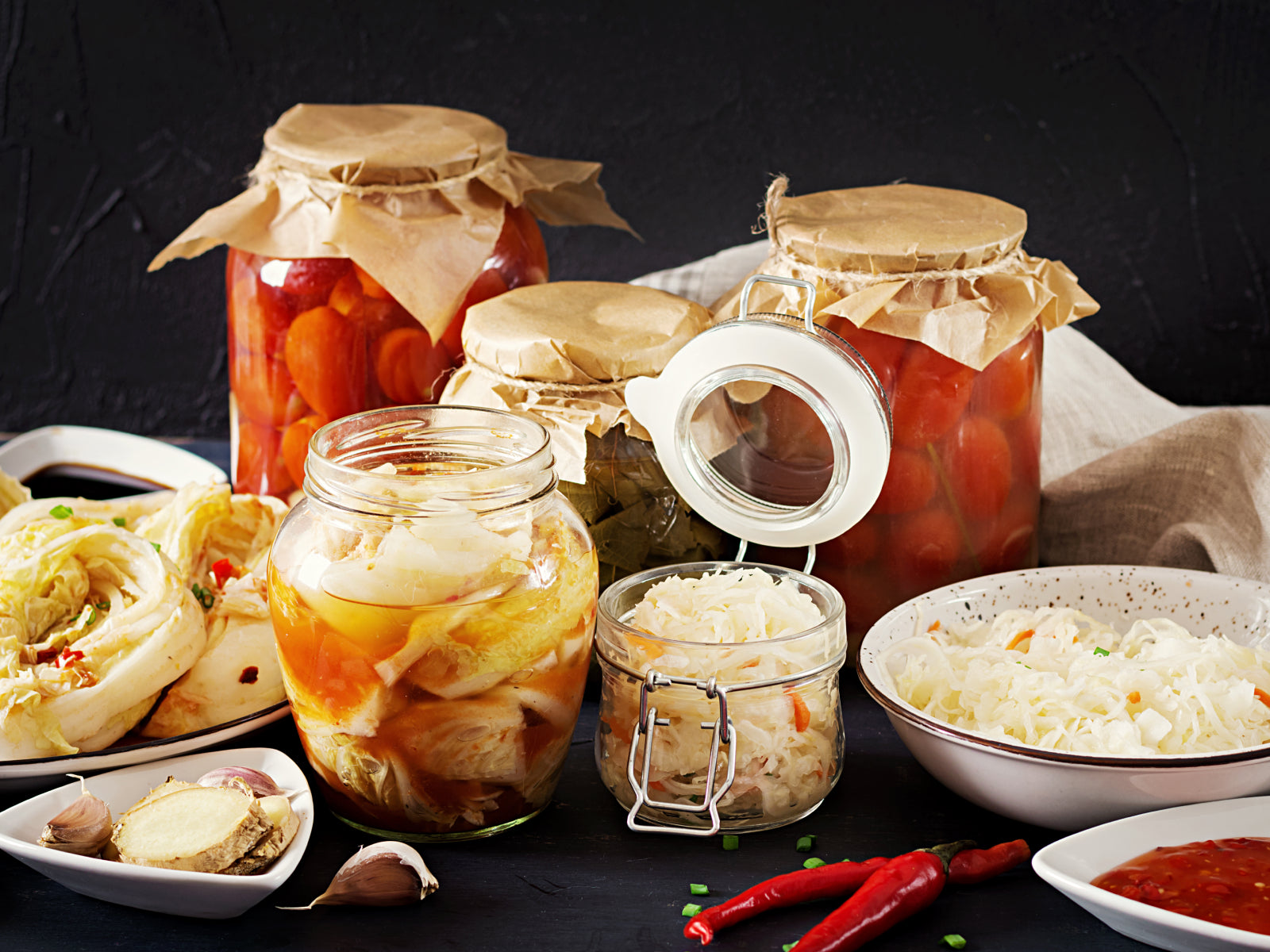
There are two main methods. Foods can be fermented naturally, known as “wild ferments” or “spontaneous ferments”, where the microorganisms are present naturally in the raw food or processing environment. This is the case with sauerkraut, kimchi, and certain fermented soy products.
Foods can be also fermented via the addition of starter cultures, often referred to as “culture-dependent ferments”, for example, yogurt, cheese, wine, beer kefir, kombucha, and natto.
What is the Definition of Fermented Food?
According to The International Scientific Association for Probiotics and Prebiotics (ISAPP), an expert panel convened to clarify the inconsistencies around the term ‘fermented’; fermented foods and beverages are “foods made through desired microbial growth and enzymatic conversions of food components”.
This definition includes food items that are made by fermentation but might not necessarily have the live bacteria, when we consume them. Meaning that although in some part of the processes the bacteria are inactivated or extracted, these products still belong to the category of fermented foods.
A clear example of this is leavened bread where the baking process eliminates the microorganisms or some beers and wines where the bacteria are removed from the final product.
Not All Fermented Foods are the Same
There are probably a myriad of different types of fermented foods consumed worldwide. Although the formal definition of fermented foods is very broad, it is important to take into account some practical aspects to choose those that benefit our intestinal health the most.
But the question that arises so often is whether all these items are equally beneficial. Is it the same to eat yogurt, kimchi, sauerkraut, or drink kombucha?
How Should I Shop for Fermented Foods?
Here we present three basic aspects that you should think about when choosing what to buy:
1. Does the fermented foods contain living microorganisms?
The most important distinction is whether or not the fermented foods contain live microorganisms at the time of consumption. The key is to read the packaging labels and look for statements like “contains live and active cultures” or some products will also list the microbial strains that they contain. The single claim “foods made by fermentation” does not ensure the presence of living microorganisms.
2. Watch out for added sugar
Unfortunately, many products that we normally perceive as “healthy” are loaded with amounts of added sugar that exceeds the recommended limits. This is the case of flavored yogurts or versions of kombucha that we find on supermarket shelves.
Here once again it’s a good idea to get used to reading food labels and checking ingredients, to choose products in their natural format, with lower sugar, or sugar-free.
And don’t be fooled: Sugar can be named in various ways, such as corn sugar, dextrose, fructose, glucose, high-fructose, invert sugar, isoglucose, maltose, molasses, or sucrose to name just a few!
3. Try fermenting at home
Despite the rumors, fermenting isn’t that complicated. It takes a bit of preparation and then the bacteria do all the hard work.
If you are up for experimenting, you could start with one of the simplest fermented foods to do at home: sauerkraut. Easy to make, requires very little special equipment, and tastes delicious.
Recipe: Homemade Sauerkraut
Ingredients
- cabbage
- 1,5-2 teaspon salt per 0,5 kg. of cabbage
Instructions
- Remove the outer and damaged leaves of your cabbage. Discard. Cut out the core and rinse well, allowing the water to flow between the leaves. Drain well.
- Weigh your cabbage to see how much salt you need to use.
- Reserve 1 outer leaf. Thinly shred the remaining cabbage with a knife or food processor. Place in a large bowl. Sprinkle the salt over the cabbage and toss well. Let sit for 15 minutes.
- Massage the cabbage with your hands for 5 about min. The cabbage should release some liquid during this time.
- Pack the cabbage into a very clean glass quart jar. Pour the liquid that was released during kneading on top. Cut a circle the same diameter as your jar out of the reserved cabbage leaf. Place it on top of the packed-down cabbage. Place a weight on top of the cabbage to ensure that it stays under the brine. If the brine doesn’t completely cover the cabbage and weight, top off with a 2% solution of saltwater.
- Screw a plastic lid onto the jar. Place the jar in a rimmed pan (to catch possible overflow) and allow to ferment at room temperature until the kraut is as sour as you like it. This can take from 1 to 4 weeks.
- After it’s done fermenting, store the sauerkraut in the refrigerator.
Do you want a look into your personal gut microbiome and what bacteria you have, then you can get insight with a gut microbiome test from Unseen Bio.
If you want to dive deeper into the gut microbiome, then listen to our podcast "Mikrobiomet" (The Microbiome), where we explore everything science knows about gut health and the microbiome together with a broad range of microbiome experts.
You can also read more about different food’s impact on the gut microbiome in our other articles.
Listen to our podcast Read our microbiome articles
By Cecilia Clausen (Clinical Dietitian)


