


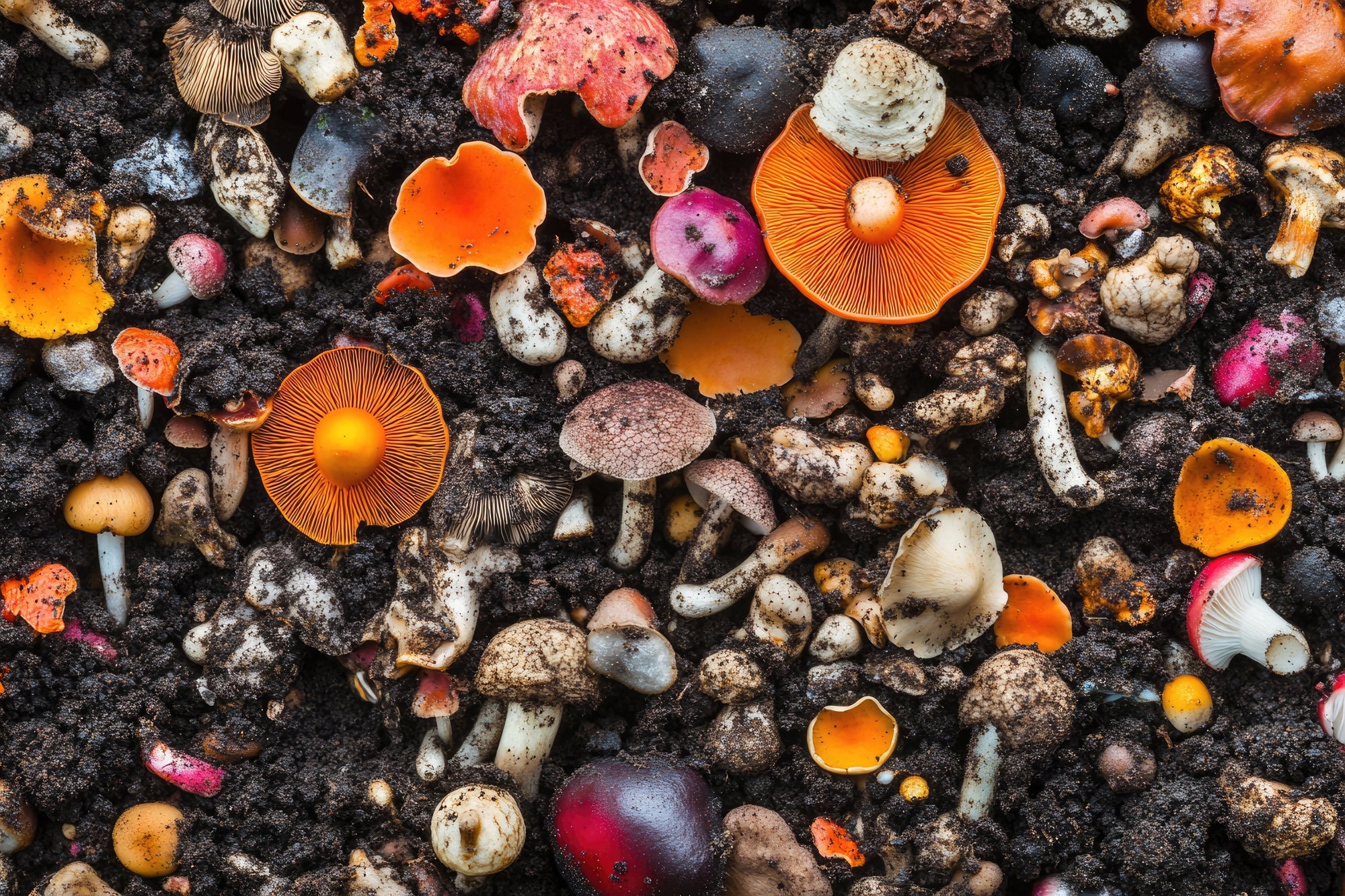
The Fungi Community in Your Gut: Colonizers or Environmental Gut Tourists?
The human gut is home to a complex microbial ecosystem composed of a huge variety of species including bacteria, archaea, viruses, protists, and fungi called the gut microbiome. For the last 15 years, science has put a lot of effort into understanding the role of bacteria in human physiology and disease development. But other communities - such as fungi - also play an important role in health and disease.
Let’s take a closer look at the fungal component, known as “the mycobiome”, to see why they matter for your gut health.
Fungal Communities in the Gut
Fungi constitute a minor component of the entire gut, representing only 0.1% of the total microbes. Yes! So little and maybe this can explain why despite their importance, they remain poorly understood.
However, in the last few years scientific efforts to characterize the “healthy” human microbiome, have shed some light on the function of the mycobiome.
Compared to bacteria, the human gut mycobiome is low in diversity with generally less than 20 species identified.
Studies suggest that both inter-and intra-individual variability are high. Meaning that, unlike bacterial communities, an individual’s mycobiome is no more similar to itself over time than to another person’s.
Despite this fact, several fungal species identified across samples of many studies, suggest that a core gut mycobiota may exist. Interestingly, the high prevalence of ten identified genera allows a deeper characterization of the fungal microbiome.
And the list of species is likely to evolve as analytical techniques improve and the amount of data increases.
According to most studies, yeasts from the genera Saccharomyces, Malassezia, and Candida have been the dominant fungi found in stool samples.
Saccharomyces spp. are widely used in the food and beverage industries, so they are likely to be found in foods like wine, bread, or beer. And Malassezia spp. is a well-known resident of the skin.
While questions still abound on whether Saccharomyces and Malassezia should really be considered true residents of the gut, species of the genus Candida are considered true gut symbiotic fungi.
Fungal-Bacterial Interactions in The Gut
Commensal bacteria are incredibly beneficial to our health for so many reasons. They influence the way we absorb food nutrients, help us fight against pathogen colonization, maintain epithelial barrier integrity, and also participate in our immune responses.
But, a stable balance of all our microbes seems to be the key to optimize health and ensure that all these functions are performed properly.
We know that a competitive association exists between bacterial and fungal microorganisms in the gut. Bottom line: bacterial-fungal interactions are essential to prevent the overgrowth of microbes and the development of disease.
Candida Albicans, The Major Fungal Species in The Human Gut
Candida albicans is a type of fungi frequently found in the feces of healthy humans, where it generally causes no problems.
So, why is it always linked to bad press?
Certain conditions, such as an imbalanced gut microbiome, a suppression of the immune system, and an impaired intestinal barrier can lead to C. albicans infections.
The overgrowth of this benign organism is something that we can detect with testing and prevent future health complications.
The fungus can colonize multiple parts of the body in addition to the gut. Disseminated candida infections typically occur in the vagina, mouth, and throat in individuals with debilitated immune systems. Although they negatively impact the quality of life, they disappear with proper diagnosis and treatment.
More rarely, it can also spread from the gut into the bloodstream and invade internal organs producing invasive, life-threatening infections.
Do you want to check if you have Candida Albicans in you gut, then get insight into your microbiome with a microbiome test from Unseen Bio.
Fungi, Gut Immunity and Inflammatory Bowel Disease
It is widely accepted that fungal communities are not only altered in disease but also play a role in intestinal homeostasis and influencing systemic immunity.
Bacteria-fungi associations are crucial for maintaining this balance and protecting us from getting sick.
Interestingly, fungi of the gut can influence immune responses by reducing or promoting local inflammatory responses.
Apparently, C. albicans is a central modulator of human T helper 17 (Th17) responses in health and during intestinal inflammation. Dysregulated Th17 responses contribute to local inflammatory disorders, such as inflammatory bowel diseases.
The gut is a very complex ecosystem where disturbances in any of its components can greatly affect our health.
Key Points:
- Mycobiome research is an emerging component of the gut microbiome but this field is still in its infancy
- A core gut mycobiome may exist and it is likely composed of ten genera found in the majority of human gastrointestinal tracts.
- Fungal diversity in the gut is low compared with bacterial communities.
- Further investigation is required to answer whether true fungal intestinal colonizers exist or fungi are only transiting.
- Intestinal fungi shape immune and metabolic responses in various ways.
- A promising future: Understanding of normal versus dysfunctional host-fungal interactions will improve our capacity to improve health and personalized treatments.
If you want to dive deeper into the gut microbiome, then listen to our podcast "Mikrobiomet" (The Microbiome), where we explore everything science knows about gut health and the microbiome together with a broad range of microbiome experts.
You can also read more about how your life style and the different food groups impact the gut microbiome in our other articles.
By Cecilia Clausen (Clinical Dietitian)
References:
Chin, V. K., Yong, V. C., Chong, P. P., Amin Nordin, S., Basir, R., & Abdullah, M. (2020). Mycobiome in the Gut: A Multiperspective Review. Mediators of inflammation, 2020, 9560684. https://doi.org/10.1155/2020/9560684
Forbes, J. D., Bernstein, C. N., Tremlett, H., Van Domselaar, G., & Knox, N. C. (2019). A Fungal World: Could the Gut Mycobiome Be Involved in Neurological Disease?. Frontiers in microbiology, 9, 3249. https://doi.org/10.3389/fmicb.2018.03249
Kumamoto, C. A., Gresnigt, M. S., & Hube, B. (2020). The gut, the bad, and the harmless: Candida albicans as a commensal and opportunistic pathogen in the intestine. Current opinion in microbiology, 56, 7–15. https://doi.org/10.1016/j.mib.2020.05.006
Martins, C., Brandão, T., Almeida, A., & Rocha, S. M. (2017). Metabolomics strategy for the mapping of volatile exometabolome from Saccharomyces spp. widely used in the food industry based on comprehensive two-dimensional gas chromatography. Journal of separation science, 40(10), 2228–2237. https://doi.org/10.1002/jssc.201601296
Perez JC, Fungi of the human gut microbiota: Roles andsignificance, International Journal of Medical Microbiology (2021),DOI: https://doi.org/10.1016/j.ijmm.2021.151490
Richard, M.L., Sokol, H. The gut mycobiota: insights into analysis, environmental interactions, and role in gastrointestinal diseases. Nat Rev Gastroenterol Hepatol 16, 331–345 (2019). https://doi.org/10.1038/s41575-019-0121-2


